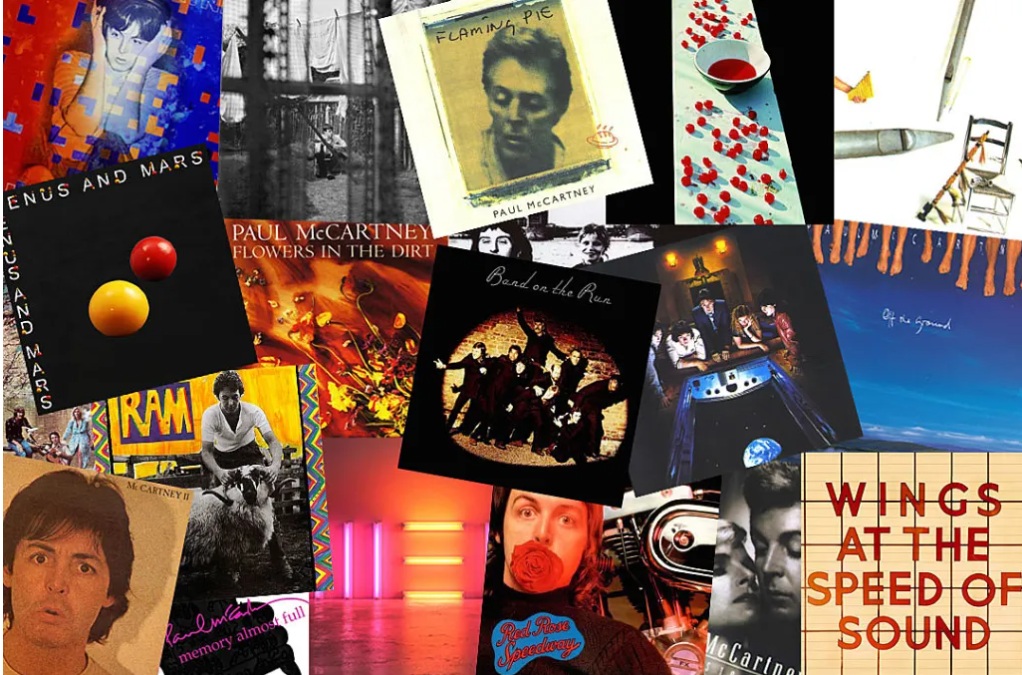
For a new listener approaching Paul McCartney's solo catalog, the first challenge is its size. Eighteen studio albums released between 1970 and 2020. Add Wings (seven studio albums), classical projects (five), the Fireman (three), and various compilations and live releases, and the total reaches well over forty records.
This guide is for the listener who wants to understand the solo catalog specifically: the eighteen albums Paul released under his own name. Wings is treated separately, as is the orchestral and Fireman work. The intent is not to rank them but to place each one in its context, so a new listener can find an entry point that fits their interests.
The DIY trilogy
These three albums share a common method: Paul plays nearly every instrument, often alone in a home studio, with minimal outside collaboration.
McCartney (1970)
Recorded mostly at home on a four-track during late 1969 and early 1970, this album was released two weeks before the Let It Be film and effectively confirmed the Beatles' end. Maybe I'm Amazed is its monument. The rest of the record is deliberately ramshackle, full of fragments and instrumentals. Critics dismissed it on release. It is now considered foundational for what would later be called bedroom pop.
McCartney II (1980)
Recorded at home in the summer of 1979 in the wake of Wings' Japan tour cancellation and Paul's brief Japanese imprisonment for cannabis possession, McCartney II is the most sonically experimental album in his catalog. Coming Up, Temporary Secretary, and Waterfalls push into early-eighties synth-pop territory before that sound was widely understood. The album was puzzling on release and has been substantially reassessed since.
McCartney III (2020)
Recorded at Hog Hill Mill in Sussex during the early months of the COVID-19 pandemic, McCartney III completes the trilogy. It is the most reflective of the three, with songs like Pretty Boys, Women and Wives, and Long Tailed Winter Bird leaning into Paul's age rather than away from it. Critical response was warm, with Pitchfork awarding it a 7.1.
Entry point: McCartney II if you like adventurous production. McCartney III if you want the most consistent songwriting.
The Linda McCartney album
Ram (1971)
The only album credited jointly to Paul and Linda. Recorded in New York with session musicians including future Wings drummer Denny Seiwell, Ram was savaged on release and has since been rehabilitated as one of the most influential records of its decade. Uncle Albert/Admiral Halsey, Too Many People, The Back Seat of My Car, and Monkberry Moon Delight are the standouts. The 2012 Library Collection reissue is the recommended edition. (See our full Ram retrospective for the complete story.)
Entry point: Start here if you like compositional ambition and unusual texture.
The post-Wings 1980s
Wings dissolved in early 1981. The four albums that followed represent Paul's most commercial period as a solo artist, with mainstream production and major collaborators. The 1980s catalog is the period most contested by critics; some hear it as Paul at his most polished, others as Paul at his most diluted.
Tug of War (1982)
Produced by George Martin in his first full McCartney production since the Beatles. Features Ebony and Ivory (with Stevie Wonder) and Here Today, Paul's elegy for John Lennon. Often cited as Paul's strongest 1980s album.
Pipes of Peace (1983)
A direct sequel to Tug of War, sharing producer, sessions, and several musicians. Includes Say Say Say with Michael Jackson. Less consistent than its predecessor.
Give My Regards to Broad Street (1984)
The soundtrack to Paul's box-office-failing film of the same name. Mixes new material with re-recorded Beatles songs. Considered a low point at the time, partially reassessed since.
Press to Play (1986)
A deliberate stylistic reset, produced by Hugh Padgham. Features collaborations with Eric Stewart of 10cc. Commercial disappointment on release; modest cult status now.
Entry point: Tug of War if you want the best of the period.
The Russian curiosity
Снова в СССР / Choba B CCCP (1988 / 1991)
An album of rock and roll covers recorded in two days in 1987, released only in the Soviet Union in 1988 in a deliberate gesture toward Soviet listeners who had been unable to legally purchase Western music. Released worldwide in 1991. Not a major artistic statement but a fascinating historical artifact. Maccafan covers the album in depth in our library section.
The late-eighties and nineties
Flowers in the Dirt (1989)
Produced with Mitchell Froom and others, with co-writes by Elvis Costello. The Costello collaborations (My Brave Face, You Want Her Too, Don't Be Careless Love) are the album's high points. A genuine return to form after the 1980s commercial wobble.
Off the Ground (1993)
Recorded with the touring band Paul had assembled for the New World Tour. Less essential than Flowers in the Dirt but contains the underrated Hope of Deliverance and Off the Ground.
Flaming Pie (1997)
Produced by Jeff Lynne and George Martin during the Anthology period, with Ringo Starr on drums on three tracks. Paul has called it the album he made because Anthology reminded him of the standards he wanted to reach. The Song We Were Singing and Calico Skies are particular highlights. Widely considered his best album of the 1990s.
Entry point: Flaming Pie. If you want one Paul album from the 1990s, this is it.
The 2000s renaissance
Run Devil Run (1999)
A rock and roll covers album, recorded in a week with David Gilmour and Mick Green, made in the wake of Linda's death from breast cancer. Cathartic and unexpectedly raw.
Driving Rain (2001)
The first album of original material after Linda's death. Recorded in California with producer David Kahne. Includes the only Beatle-on-Beatle collaboration with George Harrison after the Anthology sessions, on Vanilla Sky.
Chaos and Creation in the Backyard (2005)
Produced by Nigel Godrich (Radiohead, Beck), who pushed Paul to play most instruments himself in a deliberate echo of McCartney and McCartney II. The result is the strongest review-driven album of Paul's solo career, nominated for Album of the Year at the 2006 Grammys.
Memory Almost Full (2007)
A lighter follow-up to Chaos, also self-played in significant portions. Includes Dance Tonight and Mr. Bellamy.
Entry point: Chaos and Creation in the Backyard. If you want one Paul album from the 2000s, this is it.
The 2010s
Kisses on the Bottom (2012)
A standards album of pre-rock-era covers, with a Diana Krall band. Often overlooked but quietly excellent for what it is.
New (2013)
Produced by Mark Ronson, Ethan Johns, Paul Epworth, and Giles Martin, with each producer handling a few tracks. The youngest-sounding album Paul has made since the 1980s. Save Us, New, and Queenie Eye are the singles.
Egypt Station (2018)
Produced by Greg Kurstin (Adele, Kelly Clarkson) and Ryan Tedder (OneRepublic). His first US number-one solo album since 1982's Tug of War. I Don't Know and Confidante are the standouts.
Entry point: Egypt Station. The most consistent late-period Paul album before the McCartney III trilogy capper.
Recommended listening order for new listeners
If you have never seriously engaged with Paul's solo catalog, a five-album introduction would be:
- Ram (1971) — The compositional and textural blueprint
- Flaming Pie (1997) — The post-Anthology craftsmanship benchmark
- Chaos and Creation in the Backyard (2005) — The most critically acclaimed late-period album
- McCartney II (1980) — The most experimental work
- McCartney III (2020) — The trilogy capstone and the late style
These five records, listened to in sequence, will give a new listener a working sense of Paul's solo career: its variety, its evolution, its preoccupations, and its persistent strangeness. From that base, any of the other thirteen studio albums become more navigable.
The Wings catalog, the classical work, and the Fireman albums are separate guides. We will publish each in due course.
For a deeper dive into individual albums, our Albums library contains track-by-track notes and recording histories for the entire catalog, written by Pierre Rattaire and contributors over the past twenty-five years.