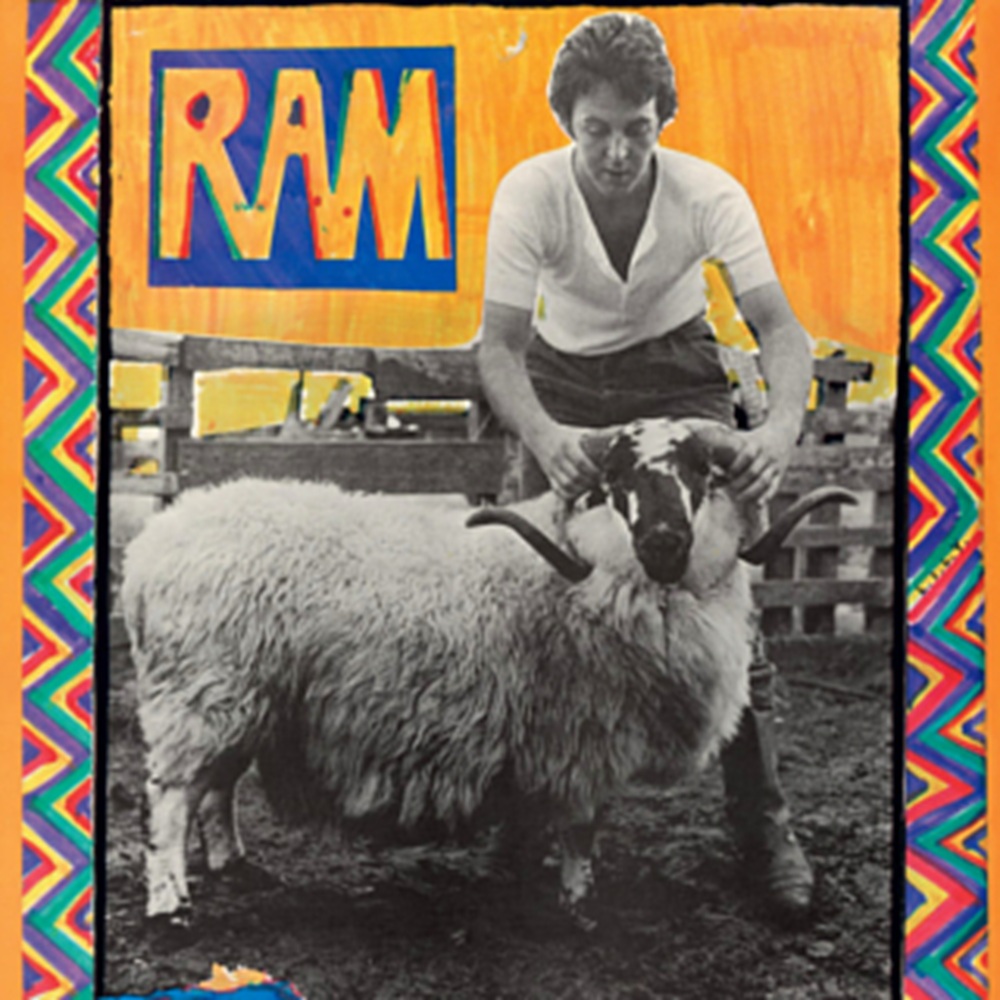
In May 1971, Paul and Linda McCartney released an album that critics buried on arrival. Jon Landau, writing in Rolling Stone, called it "the nadir in the decomposition of Sixties rock thus far." Robert Christgau gave it a C. The general mood, in a year already crowded with John Lennon's Imagine and George Harrison's All Things Must Pass, was that the lightest Beatle had finally proven himself a lightweight.
Half a century later, Ram is one of the most influential records of its decade. It has been covered in its entirety by multiple artists. Its songs turn up in younger musicians' record collections with the regularity of a foundational text. Pitchfork, reviewing the 2012 reissue, gave it a perfect score. Indie pop, as a sound, sometimes seems to be reverse-engineered from this single album.
How a record gets from "nadir" to "foundational text" is a story worth telling.
The making of an outlier
After his 1970 debut McCartney, an album recorded almost entirely alone at home in the months following the Beatles' collapse, Paul wanted something more polished. He and Linda flew to New York in October 1970 to begin work on the follow-up, holding auditions for musicians in a 45th Street attic and a Bronx basement. Some auditioning players were brought in under the guise of recording a commercial jingle, the McCartneys keeping the real project quiet. Guitarist David Spinozza was recruited first, with drummer Denny Seiwell, soon to be a founding member of Wings, brought in shortly after.
Basic tracks were taped at Columbia's Studio B between October and November 1970, with additional sessions at Studio D, A&R Recording Studios, and finally Sunset Sound Recorders in Los Angeles, where Norwegian engineer Eirik Wangberg took over mixing duties from producer Jim Guercio and finished the album over six weeks. Paul gave Wangberg unusually free rein. Among Wangberg's decisions: stitching two unfinished songs together to create Uncle Albert/Admiral Halsey, and adding the artificial-stereo thunder effects that open its second half.
The album was credited to Paul and Linda McCartney, the only studio album to bear that joint billing. Linda's vocal contributions were primarily harmonies, but her presence on the credits was, at the time, controversial. Paul has since acknowledged that the joint credit had practical implications around publishing royalties; it was also, plainly, a statement.
Why critics hated it
The hostility Ram received in 1971 makes more sense in context than it does in retrospect. The Beatles had broken up the previous year, and the rock press of 1971 was actively choosing sides. John Lennon was making confrontational, politically engaged solo records. George Harrison had delivered a triple-album spiritual epic. Paul, by contrast, made a record about his wife, his farm, and his sheep.
Lennon himself heard slights in it. Too Many People opens with the line "too many people preaching practices," which Lennon took as a direct attack and answered the following year with How Do You Sleep? on Imagine. The opening words of Ram, when reversed, are reportedly a half-audible "piss off." For listeners hoping to find the next Beatles record in this sleeve, what they got instead was domestic, eccentric, and almost willfully unfashionable.
Christgau called it "the most stupid mainstream rock record of the past few years." Landau's Rolling Stone review went further, accusing Paul of having needed Lennon's editorial discipline to produce anything of value. The consensus formed quickly: Ram was the sound of a major artist losing the plot.
Why it mattered anyway
Several things were happening in Ram that took the rock press a generation to catch up to.
The first is its compositional restlessness. Songs like Uncle Albert/Admiral Halsey and The Back Seat of My Car are essentially mini-suites, structurally closer to the Abbey Road medley than to anything on Lennon's Plastic Ono Band. Monkberry Moon Delight, which Paul's adopted daughter Heather sings backing vocals on, is a piece of vocal-led baroque pop that has been covered by everyone from Screamin' Jay Hawkins to Phish.
The second is its texture. The combination of Spinozza and Hugh McCracken's interlocking acoustic guitars, Seiwell's loose, jazz-inflected drumming, and Linda's high harmonies created a sound that was simultaneously homemade and elaborately produced. This combination of "sounds like it was made on a farm" with "actually has George Martin string arrangements on three tracks" is exactly the formula that two generations of indie-pop artists have spent years trying to reverse-engineer.
The third is its emotional ambiguity. Ram refuses to commit to either the rural-domestic warmth its cover promises or the embattled-defensive posture its opening lines establish. The result is a record that feels strange and unresolved in ways that more straightforwardly autobiographical singer-songwriter albums of the era do not.
The long second life
The first signs of critical reappraisal came in the late 1990s, when artists like Jon Brion and the High Llamas began citing Ram as a touchstone. The Brion connection mattered: he produced records for Aimee Mann, Fiona Apple, and Kanye West, and the Ram-derived production tricks (close-miked acoustic guitars, tightly stacked vocal harmonies, deliberately rustic textures) showed up in his work and spread from there.
By the time Pitchfork's Mark Richardson reviewed the 2012 Library Collection reissue, the consensus had completely flipped. Richardson awarded Ram a 9.1, calling it a record whose "supposed flaws now sound like its great achievements." The review explicitly framed Ram as the unacknowledged template for indie pop, naming a lineage from Brian Wilson through Ram to artists like Of Montreal and Animal Collective.
Rolling Stone, which had buried the album in 1971, ranked it number 450 on its 2023 list of the greatest albums of all time. The mid-list placement is itself a kind of admission: Ram was always there; the publication just didn't know how to hear it.
The McCartney III connection
There's a direct line from Ram to McCartney III, the 2020 lockdown album that closed Paul's solo trilogy. Both records were made under deliberately constrained circumstances. Both feature Paul playing most instruments himself, with family members contributing where appropriate. Both arrived without the weight of expectation that attended the records around them, and both used that absence of expectation to do something stranger than they would have been allowed to otherwise.
The trilogy that McCartney III completes is sometimes described as the trilogy of Paul's solo records, but that framing misses the point. Ram is just as essential to the lineage. Together, McCartney, Ram, McCartney II, and McCartney III form the backbone of a four-decade investigation into what one Beatle does when no one is watching.
The answer, on this evidence, is something pretty close to indie pop, decades before anyone had a name for it.